
How photographers got photos to newspapers before the internet.
(Longer than a one minute read)
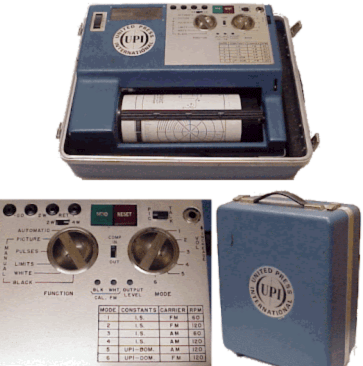
Harkening back to the days before digital cameras, or even digital scanners (outside of printing and graphic arts companies), a small machine was responsible for allowing the newspaper readers of the world, to see in pictures, the news and sports of the day.
The United Press International news agency developed a system that was utilized by their photo teams across the world, and it relied only on a plain analog telephone line. There is a good article on Peta Pixel where Dallas Morning News photo director Chris Wilkins describes how the system worked.
Back in my days as a photographer and photo editor for my college newspaper, I had the chance to see this beauty in action, this being in 1981. A UPI photographer who’s name I can’t recall, had contacted our newspaper office in a mild panic as he had been quickly assigned to cover a sports event and needed a) to get his film developed, b) make a print or two, and c) get the photos sent to home office over wire. And all this in preferably under an hour to make the deadline. I assigned myself to be his facilitator for this mission.
The film developing and printing was not problem as we used a dip-and-dunk process in the newspaper darkroom for black and white film, where the developer (HC110-A) was always ready and at temperature (room temp around 68F), along with the stop bath, fixer, and hypo clear. The system was just four 4″ PVC pipes capped at the bottom, and a perfect fit for Patterson plastic reels. A two and a half gallon container with spigot held HC110 replenisher, and if I recall correctly, just added one ounce to the developer pipe for each roll developed, and the developer level was maintained as well from use.
So the entire process unfolded like this: I was at the sporting event shooting as well, a football game, and the stadium was about a 20 minute walk back to the newspaper office. Well, that wasn’t going to work, and a car would not have been any faster given the road closures for game day, and usual traffic. So run we did. I think that took 10 minutes. 50 minutes to go.
Into the film darkroom he went, and got the film reels loaded, in the developer for 3 1/2 minutes, what was likely just a quick dunk in the stop, then into the fixer for only as long as it took to clear the film, probably 1 minute, dunk into the hypo clear, then probably 30 second wash. We had a hot air dryer that would dry the film while still on the reels that usually took about 3 minutes. 10 minutes tops. 40 minutes to go.
After looking through the developed film on a light table, the photographer chose about three images as I recall, and then into the wet lab for printing (the lab always had developer, stop, fix, and wash trays in process 24 hours a day.) Checking the film and making prints was probably around 15 minutes. 25 minutes to go.
This is where our fun little machine comes in. We headed up to my desk in the newsroom, where I had the standard dial telephone. First step was to call the telephone number for the photo receiving department and establish a connection. Once given the go ahead, he removes the transmitter/microphone from the handset, and with two alligator-clip wires connects the photo scanner. He previously chose the best picture to send, and has already loaded it up on the scanner while making the call.
My memory is a bit fuzzy on how long it took to transmit this one photograph, but I believe it was on the order of 15-20 minutes or so. So after the last line was scanned, 25 minutes later, the deadline had been met.
I’m sure this seems like ancient history compared to the internet of things we have today, and actually it pretty much is.
- gregory gammon / http://www.vinylfye.com
 One-Minute Reads about Film Photography
Leave a comment