
Temperature control for black and white film developing – A Two Minute Tutorial
A previous post on film reticulation talked about the importance of consistent temperature across all the steps in film developing. Here are some tips on HOW you can manage temperature control easily for black-and-white film, even if you are in a naturally hot or cold environment, particularly when it comes to wash water from the faucet. Color film temp control will be in another post.
Room temperature is the “norm” for most black-and-white films, with literature calling for 68 F (20 C) as the standard. Let’s just go with that for now. There are ways to manage hotter and colder temps, but this is a good standard to go with.
If your “room temp” tends to be warmer, get a jug (gallon is adequate) of colder water, even ice water can be used. If cold, get some warmer water. This will be used for mixing water for the various steps. I recommend having five one-quart containers (for most tank sizes) to prepare all of the solutions.

Starting with pre-wash, use a mixture of tap water (warm) and some cold water from the jug to get to 68 degrees. I recommend a pre-wash as a way to acclimate the film and developing tank to the temperature before the developer hits. Some trial and error and experimentation will make the temperature mixing easier.
Developer is usually pre-mixed and stored. If it is warmer than 68, immerse it in an ice bath for a short time, or in the converse case, in hot water. You can quickly get the solution to the correct temp this way.
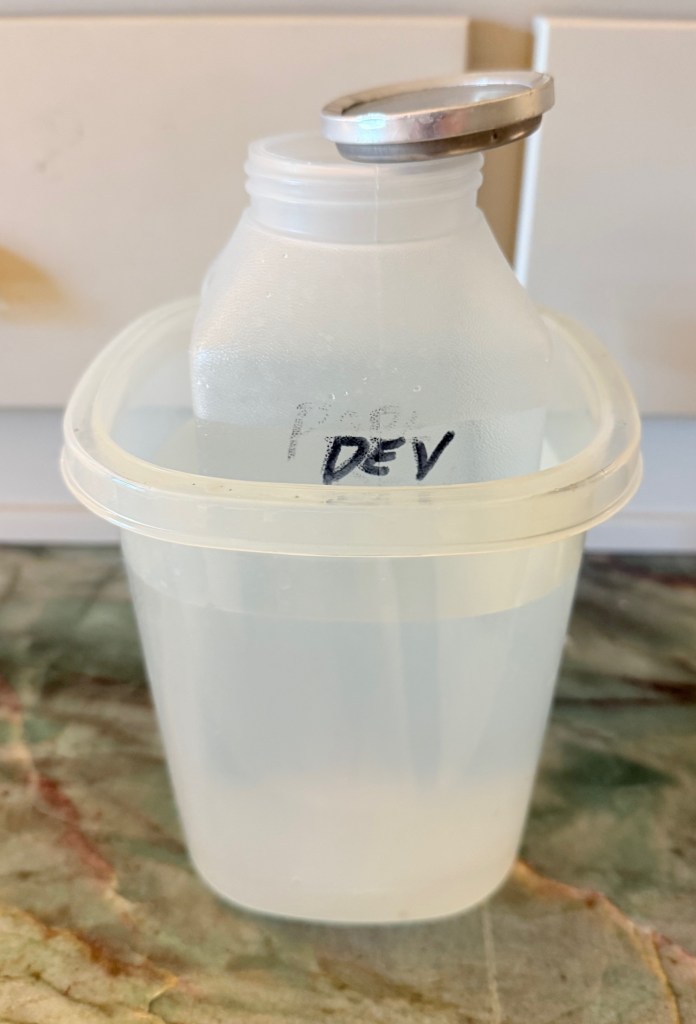
Mix stop bath and hypo-clear with water mixes similar to the pre-wash. Bring fixer to the correct temp in the same way the developer was done.
Here’s the secret sauce: You don’t have to worry about the temperature of your wash water if you introduce it SLOWLY into the tank after the hypo-clear. Leave hypo-clear in the tank and just start a very slow run, allowing the temp of the water in the tank to gradually change. This avoids reticulation and makes the wash simple to accomplish.
- gregory gammon / www.vinylfye.com
 One-Minute Reads about Film Photography
Leave a comment